Posts

Showing posts with the label New Jersey

Nature Note #149: A Familiar Grind

As the dog days of summer trudge on, those of us in the world of adult responsibilities grind along too. We have jobs, appointment, and lives to lead regardless of how hot the weather and how inviting the sunshine is outside. Despite this, there is a familiar sound that punctuates the noise and grind that surrounds our everyday lives. Even as I've grown more and more used to life here in the city, noise still finds a way to puncture through. Recently I was listening to an episode of Roman Mars's podcast,  99% Invisible  where he discussed the difference between noise and sound. Noise is a sound or series of sounds that are annoying or disturbing to one's overall experience of the world, while a sound itself was the expulsion of air waves of a certain pitch and frequency that we recognize coming from a specific source, regardless of the impression it has on our experience of the surrounding world.  There is certainly no doubt that cities are noise centers. Rumbling tra...

Nature Note #123: All Terned Around in Cape May

Image
All puns aside, this is a post about the Whiskered Tern ( Chlidonias hybridus ) (sort of) and my visit to Cape May on Sunday. After working all last week and seeing report after report of this Code 5 Whiskered Tern at the state park at Cape May Point, I made the 2 1/2 hour journey from Horsham to Cape May and started my quest for the tern. After arriving at 10:45am and asking around at the hawkwatch platform, I was dismayed to find out that it had been visiting regularly in the afternoon instead. Despite this setback, I decided to comb the park for some year birds instead. I didn't have to wait long as I secured two Little Blue Herons ( Egretta caerulea ) and a Pied-billed Grebe ( Podilymbus podiceps ) on Bunker Pond, as well as a Blue-winged Teal ( Anas discors ) on the nearby ponds. The skies and bushes were filled with the sounds of nature. Overhead migrating raptors like Ospreys ( Pandion haliaetus ), an immature Bald Eagle ( Haliaeetus leucocephalus ), and soaring Turkey Vultu...

On the Wing #72: Visiting the Negri-Nepote Grasslands

Image
Apologies for the late entry, but I have finally gotten around to writing this week's entry.  This past Sunday I got the chance to visit a very cool place called the Negri-Nepote Native Grassland in Franklin Township, NJ. I came here after hearing that a pair of Dickcissels ( Spiza americana ) had been spotted the day prior. After arriving, the first birds I saw were the ubiquitous American Robins ( Turdus migratorius ) and a few pairs of Eastern Bluebirds ( Sialia sialis ), as well as hearing the jabbering song of a nearby House Wren ( Troglodytes aedon ). I'd come for two other species other than the rare Dickcissels. I found them within the first ten minutes and they were a sight to behold. The first life bird I got was a Grasshopper Sparrow ( Ammodramus savannarum ). This lovely male decided to survey his surroundings from atop this bird house support pole allowing for good pictures and lasting views. For such a furtive bird, being out in the open seemed unusual. How...

On The Wing #62: Pacifically Speaking

Image
What are you doing in New Jersey? When it comes to rarities, nothing is better than seeing a bird so out of place, it boggles the mind on how on earth it got there. That's how I felt as I spied a Pacific Loon ( Gavia pacifica ) sitting in the middle of an industrial park pond in Morris Plains, NJ at around noon today. I would've been even more pleased if I had taken pictures of it as well (It was literally 50 feet away!! -_-;;), but I'm happy to have added another lifer to my list. As I said in my posting about finding my first wild Canvasback ( Aythya valisaneria ) in Carver, MA, I quoted Sandy Komito's reaction to finding the Pink-footed Goose ( Anser brachyrhynchos ) he'd worked so long and hard to find. It was over so quickly that he literally felt guilty about how hard he'd worked to find it. Needless to say, like Komito, it was an easy bird to find. It had stayed in the same area for about a week and seemed content on moving back and forth from the i...

On The Wing #61: Birding at the Watershed

Image
While I haven't gotten out much this week due to my schedule, I just wanted to take the time to share some great photos I've taken recently around the Watershed Preserve in Pennington, NJ. So far I've listed 40 species where I'm staying and I'm am so excited for spring migration! I hope you enjoy what the wilds of New Jersey have to offer. An inquisitive Carolina Chickadee ( Poecile carolinensis ) peeks upward. A male Red-bellied Woodpecker ( Melanerpes carolinus ) in mid hop as it scales a snag. A Yellow-rumped "Myrtle" Warbler ( Setophaga coronata ) skips around the branches looking for running sap and fleeting insects A female Downy Woodpecker ( Picoides pubescens ) drinks sap drizzling from a tree trunk. Bluebird houses abound on the property. They might be used by docile bluebirds and Tree Swallows ( Tachycineta bicolor ), or by the more aggressive House Wren ( Troglodytes aedon ). Canada Geese ( Branta canadensis ) and Ring-...

On the Wing #60: "My Name is Chickadee....Carolina Chickadee"

Image
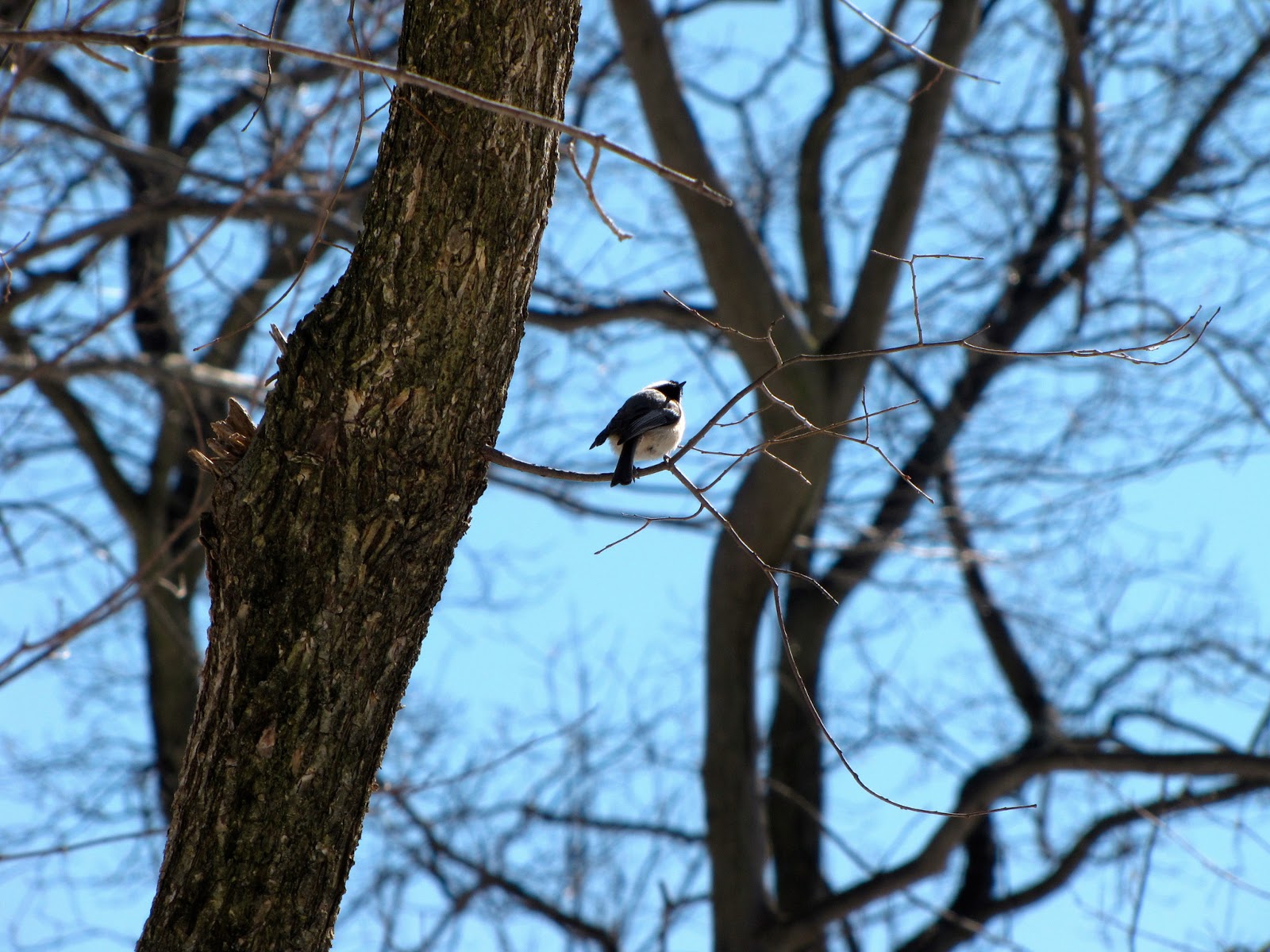
So during my first week in New Jersey I've learned two things: 1. Living on a wildlife preserve is the most amazing thing I think I've ever done in my life (which will lead to an important announcement at the end of this blog post) and 2. The main species of chickadee here are Carolina Chickadees ( Poecile carolinensis ). Now I've seen Carolinas before. Last year when I visited Assateague National Seashore (my girlfriend worked there as a plover steward), I heard their higher pitched and almost raspy calls in the trees above. Now that I'm in New Jersey however, I have hit upon an interesting problem. In New Jersey, both Carolina and Black-capped Chickadees ( P. atricapillus ) exist practically side by side, with Black-caps occupying the more northerly areas, while Carolinas are more central to southerly. Now, one would think that such a difference in range would put them on either side of a well defined line, but as any good birder will note, where their ranges seem t...