Posts

Showing posts with the label staghorn sumac

Nature Note #148: The Feeling of a Pleasant Summer Evening

Image
Imagine a quiet river ambling by on a warm summers eve. The sun is starting its downward shuffle towards the horizon and a warm glow fills the skies above. I have to be honest, I was worried about finding a quiet spot to go fishing in the city or even just outside.  Cities, in my opinion, are atrocities (no pun intended). Entirely too many people shunted into many small spaces with the expectation that they will get along with one another. It's an introverts nightmare and personally, I have made it my mission to get outside the city of Syracuse as much as possible. The city itself isn't all that bad. I'm still not used to being in such close proximity with my fellow species, Homo sapiens and don't know if time will change that, but until then, I will continue to escape to the countryside come the weekend. I'm lucky to have so many interests in the outdoors and have been blessed with an internal drive to experience nature up close. Whether it was Beaver Lake a fe...

Nature Note #119: Sipping the Sumac Pt. II

Image
So after getting up this morning, I went to the basement to check on the sumac-ade. The water that the berries were seeping in had turned a light grapefruit juice pink and tasted vaguely acidic. I took the mixture upstairs and strained it. Some of the small red berries had escaped the clusters and floated to the top. The red hairs that covered the berries also floated throughout the mixture and remained in the liquid long after straining. After straining out the liquid, I taste-tested the concoction. It wasn't terrible, but it wasn't amazing either. It was tart, but waxy in texture. I took a smaller amount in a different glass and added some sugar. It tasted a little better after that. After that I cleaned out the pitcher, refilled with the sumac-ade, and added three spoonfuls of sugar. That made the difference! Below, I've photographed the steps to making the sumac-ade. If you want more concise instructions for doing so, consult Samuel Thayer's book, The Forager...

Nature Note #118: Sipping the Sumac Pt. I

Image
As per my new year's resolution, I have chosen to go foraging more often this year and I haven't let myself down yet. While I've stuck to fairly easy uses such as leafy greens like dandelion ( Taraxacum spp. ) and lamb's quarters ( Chenopodium album ), berries like black raspberry ( Rubus occidentalis ), and my failed attempts to go after roots from the likes of evening primrose ( Oenothera spp. ) and burdock ( Arctium spp. ). Well today I decided to make a drink that I'v read about in many foraging guides, but hadn't tried until now. Like many wild foods, it goes by several colloquialisms including sumac lemonade, sumac-ade, "Indian" lemonade,  and sumac berry tea. It is in fact an infusion of freshly picked staghorn sumac berries and cold water (made bold to emphasize importance) that is left to sit so that the berries can release their sweet and slightly sour taste. The comparison to lemonade is based largely on flavor, but the first time one gaz...

Nature Note #116: Late Summer Botanicals

Image
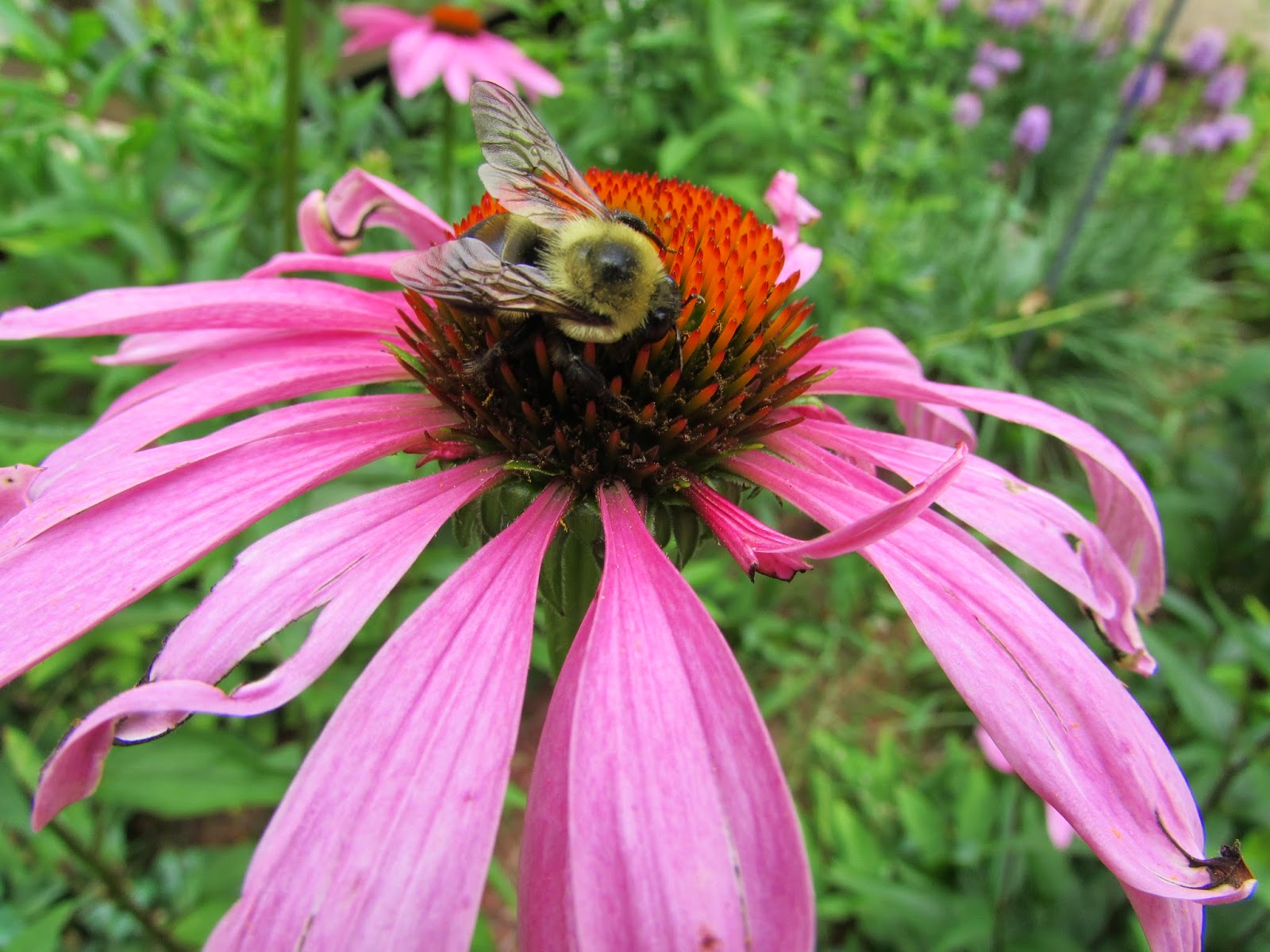
Apologies for not having posted for the past few weeks, but camp takes up a lot of time and energy during the week. So instead of a long winded explanation of my exploits over the past few weeks, I thought I'd treat you all to my photos of the flowers, shrubs, and trees I've seen over the past few weeks. I hope you enjoy them. A bumblebee ( Bombus spp. ) feeds on an Echinacea purpurea in my girlfriend's parent's garden. A presumed Dun Skipper ( Euphyes bimacula ) feeds on nectar from one of the many E. purpurea in the garden. Another close up of the skipper as it feeds on nectar using its proboscis. A Great Spangled Fritillary ( Speyeria cybele ) feeds on nectar as a bumblebee ( Bombus spp. ) intrudes. An impressive mode of feeding indeed. A presumed American Lady ( Vanessa virginiensis ) rests on a small E. purpurea . A damaged skipper rests on the petals of E. purprurea . A Day-Lily ( Hemerocallis spp. ) grows in the rough sec...