Posts

Showing posts with the label nature observation

Nature Note #203: Fiddlers on the Move

Image
Few animals are as synonymous with the ocean than the crab, ranging in size from the monstrous king crab of Deadliest Catch fame to the minute hermit crab, a favorite childhood and classroom pet. The most enigmatic can be found in the salt marshes of Bogue Sound and is easily recognized by their diminutive size and asymmetrically large claw; the fiddler crab. Of the six species of fiddler crab that can be found along the Atlantic coast line, we have three species: the Atlantic sand fiddler ( Uca pugilator ), the Atlantic marsh fiddler ( U. pugnax ), and the red-jointed fiddler ( U. minax ). Their name derives from the large claw of the males either in reference its overall size or due to their tendency to move it back and forth like a bow across the strings of the fiddle. In fact, their mating display involves the males waving their large claw back and forth in a bid to attract females. Fiddlers on the move. Photo by me. Given my inexperience with identifying crabs, I would h...

Nature Note #200: OBX

Image
I want you to think of an island and what that means to you. Go on. Imagine an island. What do you see? I reckon the first thing that popped into your head was the stereotypical deserted island. A small plot, not too big, maybe about the size of a football pitch complete with palm trees, rolling dunes, and blue waters on all sides, as far as the eye can see. Or perhaps you thought of the jagged rocky outcrops of Ireland that Luke Skywalker was hanging out on in the latest Star Wars film. Those are some good examples. The island I'm living on for the year is a little different though. Certainly it's in a warm climate with beautiful sparkling water surrounding it, but there is a lot more drama happening on the sand than one might suppose. The island I'll be living on for the year is called Bogue Banks and it is part of the barrier island chain known as the Outer Banks. This 200 mile chain of land runs from Currituck Banks in the north all the way south and east to Bogue Ban...

Nature Note #193: Being Present

Image
Imagine standing in a white pine forest while warm rays from the sun flow over your arms, neck, and face. The trees sway gently in the wind as you close your eyes, your outer layers wrapped in a pleasant heat. The air is thick with moisture as plants breathe silently around you. In the higher branches, a sound grows loudly, radiating over the entire canopy, as if ringing out of the sun itself. Another voice cries out and then another and another, until a roaring chorus blooms over the treetops. And just as quickly as it grew, like a wave retreating from shore, it pales and fades back into the branches. White pines in Lincoln, MA The summer months allow us to experience long sunny days, that power rushing thunderstorms, cooling our neighbourhoods for a brief respite from the heat and humidity. Outdoor recreation spikes with people from all walks of life wanting to escape their homes for a date with the sun. All the while, they are serenaded by secretive musicians in the trees as...

Nature Note #192: Snacking and Entering

Image
Grey squirrel, but not T.S. We share our homes and neighbourhoods with a plethora of wildlife. Deer frolic through our yards, while chickadees and titmice visit our feeders in search of a quick snack. Ants and spiders crawl under the walls of our homes, occasionally appearing to quickly dash between the cabinets in search of food. Even our pets aren't immune. Leave any of their food alone outdoors and you're sure to be visited by opossums, skunks, and woodchucks, all looking to gain access to an easy meal. While these creatures often appear in the yard, they seem to keep their distance. That is unless you've been feeding them in which case you should definitely stop. Seriously, the last thing you need is a mass of animals expecting food from you every time you appear at the door. At best, it's mildly annoying to be pestered by a deer who wants some more of those apple slices that it usually gets when you leave your house. At worst, you might be creating a ground z...

Nature Note #179: Strange Clicks and Whirring Trills

Tik. Tik. Tik. Tik-tik-tik-tik-gigigigigigigigigigigi. Tik. Tik. Tik-tik. Gigigigigigi. A high-pitched buzz, almost imperceptible shivers from the boughs of the spruce near my window. A small insect, barely a few inches long, sits on a branch. It cranks out a tune produced by it's wings rubbing against one another. This act is called stridulation and is being performed by a creature called a bush katydid. Now whether it is a northern bush ( Scudderia septentrionalis ), or a treetop bush ( S. fasciata ), or even a Texas bush katydid ( S. texensis ), I can't be certain. The fact is that my ears, as dull and imperceptive (at least compared to other animals) as they are, picked up these small vibrations used to attract a female into the male's territory. Those of us with access to trees, meadows, or even an open backyard can experience the variety of songs produced by this annual summer symphony. Their mixed signals and sounds delight us as we rest in our beds after a lon...

Nature Note #172: Macros in Marcellus

Image
After having lived in Syracuse for a year, town life in Marcellus isn't the most exciting, but it is a welcome break from the city. We no longer have to suffer the wail of sirens, the stomping of feet from our considerate upstairs neighbors, or the relentless rap music people would use in conjunction with horn honks to let their associates know that their ride was there. Fortunately away from all that ruckus, Alison and I spent Friday and Saturday at the annual Olde Home Days festival in our adopted town of Marcellus. We visited our local park to find that a whole carnival had been set up. After wandering around the makeshift carnival grounds, we decided to get a quick bite to eat there rather than going back home to our house. However, dining on carny food, while not our proudest moment, still wasn't as bad as having tried deep-fried Oreos. For anyone who has never had the pleasure of consuming deep-fried Oreos, I would recommend a more commonplace sweet treat like a slice...

Nature Note #169: Can't See the Maples for the Mayapples

Image
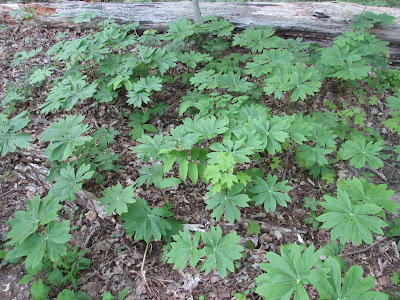
Mayapples ( Podophyllum peltatum ) When you're out for a walk in the woods, little details can sometimes be lost in the majesty of the trees towering overhead, while summer birdsong rings through the foliage. While the woods are some of my favorite places to hike and bird in, this time of year offers me a chance to see one of my favorite organisms. Plants have the uber important role in most ecosystems as the chief providers of shelter, food, and most importantly, oxygen. According to North Carolina State University's Tree Facts page , a single tree can take in up to 48 pounds of carbon dioxide per year, cementing their value as invaluable converters of this greenhouse gas into an important breathable one. However, the plants I was admiring were not the trees, but a ground level plant grows in what looks like a shrunken and out of place colony of palm trees.  The May-apple is a common woodland plant that starts to appear in the Northeast in early May and continues t...

Nature Note #163: Lawn Birds

Image
Zee-jirp! Zee-jirp! A buzzy whistle rattles the windows outside of the apartment as fog veils the trees in the valley. A little black bird sits in one of the pines, fluffing its throat feathers and glancing around. It has a bright yellow bill and jet fighter wings that let it blast around the eaves and roof like an F-16.  Three weeks ago, when we finally moved into our apartment in Marcellus, Alison and I immediately noticed the starlings nesting under the eaves of our home. The European starling ( Sturnus vulgaris ) isn't a bird that birders admit to enjoying, at least most of the time. For the purists, they are an unwelcome pest that steal nesting sites from other birds in the spring. The rest of the year is spent in roving flocks that roost in city trees and building archways and supports, leaving snowy layers of guano in their wake. While most homeowners would seek to eliminate these birds from the exterior of their homes, I see this as an opportunity to observe th...

Nature Note #159: Encounters with Audubon's Mammals (The Hudsonian Hoarder-Squirrel)

Image
Sciurus Hudsonicus, Hudson Bay Squirrel, Chickaree Red Squirrel This third installment in my series, Encounters with Audubon's Mammals features a personal favorite of mine: the American Red Squirrel ( Tamiascurius hudsonicus ). About a month ago, my girlfriend Alison and I visited Beaver Lake Nature Center in Baldwinsville, NY to watch the bird feeders. It was calming to sit and watch birds both small and not so small flit about on a bitter winter day. While the flocks of finches and other seed eaters jostled for control of the sunflower seeds above, beneath the feeders were two mammals that usually cause much trouble whenever they appear near feeders. I am of course talking about squirrels. In my first post, I mentioned how I kept seeing black squirrels all over Syracuse and how in certain parts of America, they just happen to be commonplace. In most parts of Central New York, seeing a black squirrel is practically guaranteed. The American Red Squirrel is a New World...

Nature Note #151: Those Small Moments

Image
Sycamore in the Stony Brook I feel like every once in a while you can appreciate nature in small doses. Nature has become big and that's not just because it's marketing team got better (we can thank National Geographic for that certainly). People wanting to "experience" the great outdoors, buying organic food, life listing rare and unusual species, hunting locavores (as in locavores hunting for wild food, not Ted Nugent's third favorite thing to shoot from a helicopter), and many other grandiose and specific things. Taking a sip While it certainly feels amazing knowing just how maple sap rises due to temperature fluctuations or why amphibians can breathe through their skin, taking time to appreciate a moment of pure presence can impress upon someone all the more. Take for example Monarch butterflies ( Danaus plexippus ). You see them gliding along passageways of tarmac and concrete, flapping furiously along roadsides looking to refuel not at Micky D...

Nature Note #150: Rambling on Roadsides

A flutter of wings caught my attention as I left Wegman's this morning. A Monarch butterfly ( Danaus plexippus ) flapping furiously in a southwesterly direction skimmed past my peripheral and into the bright morning sky. So small and under appreciated, yet this butterfly is simply doing what tradition has commanded it to do for thousands of years. What I've been missing the past few weeks has been an opportunity to escape the city to see the wild spread out and away like in a forest or a marsh. This is a silly idea of course, as nature doesn't simply exist solely "out there", but all around us. As one tuned into the natural world, I cannot help but notice the constant changes the world experiences day by day and season by season. With the autumn equinox having passed midweek and the prospect of leaves emblazoned against the branches that once funneled nutrients back and forth between sky and root, one can see clearly that change has arrived. As I've com...

Nature Note #145: Encounters with Audubon's Mammals ((The Floridian Wood Rabbit) of Syracuse)

Image
Lepus Sylvaticus,  Grey Rabbit* For the past few weeks, I have the regular pleasure of watching the behavior of a common mammal species out the back of my apartment. Eastern Cottontails ( Sylvilagus floridanus ) are a common sight on the "green patch" that fills the space between my apartment window and the Worker's Compensation Building not ten feet beyond.  D espite living in a mid-sized city in central New York, wildlife abounds on small green patches around the city, but are only noticed by those with the sharpest eyes and greatest awareness of the potential of their natural surroundings. My initial impression of the city was that it was a barren concrete wasteland populated largely by pigeons and sparrows, with rats running rampant in the sewers below. The only potential interlude to the hulking grey masses and hard rivers of tarmac lacing their way through a highly altered landscape are any number of city parks, playgrounds, and gardens. Syracuse is blessed...

On the Wing #8: The Norn Flyers of Middlesex

This blog entry will be shorter than most as I've injured my knee, thus preventing me from birding and updating the blog more regularly. I'll be better by next week and I hope to be able to provide a better feel for what's good for birding into the early fall. With that out of the way, I can explain the title. "Norn" is simply a corruption of the word "northern" and can be best heard through a Northern Irish accent. Therefore "Norn Flyers" refers to something northerly and with the ability to fly. While many "northern" breeding species are coming from the Arctic and northern Canada to migrate along the food rich coasts and store the vital supplies needed to migrate to their winter homes further south, the bird I'm speaking of is by no means a migrant, but does wander great distances to find food, shelter, or simply just to soar. The bird I'm referring to is the Common Raven ( Corvus corax ). Several have been spotted over Mi...