Posts

Showing posts with the label bird identification

Nature Note #201: Blue Cranes and Long Whites

Image
There is a small pond on the Trinity Center property I walk past everyday and is exceptionally buggy. Even when you are covered head to toe with 25% DEET bug spray, it seems to have no effect. The other day, as I rounded a bend, something lifted off from the top of a gnarled cedar. A tall bird croaked with agitation, flying away on long wings and extending a snaking neck. The bird in question was a great blue heron ( Ardea herodias ), a charismatic and recognizable marsh bird that is familiar to most people. Despite their common presence around wetlands, ponds, and rivers, I have heard them mistaken for another tall marsh bird, and are sometimes called "blue cranes". Immature great blue seen near Bogue Sound in Pine Knoll Shores, NC. Photo by me. Bird misidentification isn't a new issue. Even as naturalists and budding ornithologists like John James Audubon and Alexander Wilson were traveling the country identifying the birds they could; even they used colloquial n...
Nature Note #187: Devil Down Head

Image
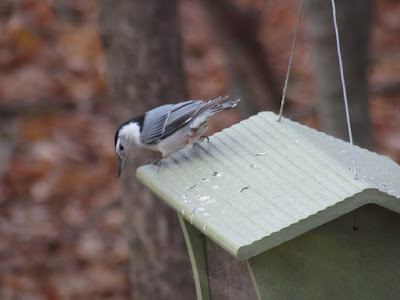
I love old nicknames for birds. Whether they are folk names, sportsmans colloquialisms, or even names from other languages, learning how other groups of people identify certain animals and plants is always an interesting journey through the history of human culture and wildlife identification. The title of this post refers to an old folk name for a common yard and feeder bird, the nuthatch. Here in the northeast, we have two species of nuthatches; the white-breasted ( Sitta carolinensis ) and the red-breasted ( S. canadensis ). White-breasted nuthatch Red-breasted nuthatch Both species are perhaps best known for their tree-scaling ability that would make any free climber jealous of their skills. Many ornithologists have been equally amazed by the skills of the nuthatch. The economic ornithologist, Edward Howe Forbush noted in his Birds of Massachusetts that: "They seem to have taken lessons of the squirrel which runs down the tree headfirst,  stretching out his hi...

Nature Note #185: Life is a Beach

Image
The sound of the ocean slapping the rocks of the causeway heralded the arrival of another car to the rutted parking lot. Over the sea wall, Horseneck Beach with its daredevil para-sailers danced over the distant swells while gulls dark and light swirled over the mile long spit jutting into Buzzard's Bay. Alison and I stepped out of the car and looked around. It was good to be home.* As we stood on the rocky shores of Gooseberry Neck in Westport, Massachusetts, we watched as sanderlings, scampered back and forth along the sands while being chaperoned by herring gulls. We sat on a few boulders that lead down the eastern side of the neck and watched the relay. The sanderlings would run towards the retreating surf to pick at the minute crustaceans and periwinkles that were caught in the pull of water and sand. After busily picking at the sands for only a few moments, they were chased back by the rushing waves to begin their relay again.  The gulls, being far less particula...

Nature Note #110: Four Thrushes and a Robin

Image
Over the past few weeks, I've been keeping track of new birds arriving on the property where I work and was delighted when the Wood Thrushes ( Hylocichla mustelina ) had returned early this month. As I walked through the woods, along a boardwalk that straddled the wet woods near my accommodations, I heard the rapid "pit-pit" calls of an alarmed bird and looked up to find a male Wood Thrush in full song. As I write this, I wanted to create another basic guide to recognizing similar looking birds after seeing the popularity and success of " On the Wing #69: Swallow, Swift, or Martin? ". After birding in the Sourlands near Hopewell, NJ today and seeing several species of thrushes, I think I've come upon the ideal topic. At this time of year, you are most likely to come across three species of thrush: the ubiquitous American Robin ( Turdus migratorius ), the aforementioned Wood Thrush, and the migrant Swainson's Thrush ( Catharus ustulatus ). The shyer Vee...

On the Wing #69: Swift, Swallow, or Martin?

Image
While my parent's were visiting me this weekend, the subject turned to the sickle-winged birds that skate over the pond on thin air, twittering as they go. I am of course referring to Tree Swallows ( Tachycineta bicolor ), one of the earliest swallows to return to the Eastern Seaboard come March and April. This came up again after I pointed out some Chimney Swifts ( Chaetura pelagica ) shooting around in the skies above Labertville, NJ. I remember my dad asking, "What is the difference between swifts, swallows, and martins then?" It was an appropriate question. They look fairly similar and can be mistaken for one another if the viewer is inexperienced. Swallows and martins are a diversely colored family of 83 species that range over much of the globe. The most common is the circumpolar Barn Swallow ( Hirundo rustica ) that nests over much of the Northern Hemisphere and likewise winters over much of the Southern Hemisphere. Generally the name "swallow" is ...

On the Wing #28: Bird-World

Image
There are those books that some of us have in our bookshelves that are from times gone by. For myself, one such book is a volume called "Bird-World" by J.H. Stickney with contributions by Ralph Hoffman written in 1898 (did I mention I love old books?) as a children's book for learning the very basics of bird identification and ornithology. The first story illustrates the core of 19th century romantic nature stories. The animals have humanistic characteristics and feelings that are conveyed through mannerisms, voice, color, size, or just about any other feature that the bird may possess. While I concede that being a children's book, some of the work is dumbed down in order to promote interest and understanding, but it would be equally valid to provide a platform that is educational, fun, and scientifically accurate towards the subject at hand. But that's just my opinion. Overall it's a cute summary of the life cycle of the American Goldfinch ( Spinus tr...

On the Wing #16: Tricky Warbler ID and Other Delights About Fall Birding

Image
After experiencing the high of finding so many warblers over the past few days, not finding anything this morning at Heard's Conservation Land was certainly disappointing, but it was made up for it by seeing a family of Northern Flickers ( Colaptes auratus ) I recognized from earlier in the summer. Even though I've only starting concentrating on warblers in the past two weeks or so, I've already run into some problems in regards to correctly identifying species (provided they don't give me "warbler neck" first or in my attempts to follow their flitting and twitching through the understory causes me to fall backwards down a hill I already had trouble climbing to begin with.) This also includes the usual issues with timing, weather, habitat choice, and of course, luck. This past week or so, I've experienced the joy of mistaking Blackpoll Warblers ( Setophaga striata ) with everything else that possesses wingbars (a feature that still annoys me in regards t...

On the Wing #6: Griscom's Legacy: Birds of Concord, Sudbury, and Wayland

Ludlow Griscom (1890-1959) while not as famous as Concord's Thoreau, Ralph Waldo Emerson, or Nathaniel Hawthorne, his presence is still appreciated by ornithologists and birders who have graced a local library and perhaps found a curious volume called "Birds of Concord". The book itself isn't a field guide, but instead a reference for any bird lover that wished at the time to better understand the mechanisms behind bird abundance and rarity as well as why migration occurred and what birds were considered common in this small, but rigorously surveyed portion of Massachusetts. Griscom himself was one of the first ornithologists to shift away from "shotgun ornithology" and instead use the field marks present on a bird body to determine its identity. Around the time of Griscom, it was common for those studying birds to have to shoot them in order to tender an identification of the bird in hand. This was certainly true for smaller, harder to see songbirds like sp...