Posts

Showing posts with the label invertebrates

Nature Note #204: Web Heads

Image
If you're as tall as I am (6' 3" to be precise) then you have no doubt experienced the horror, dread, and inconvenience caused by a spider web as it wraps around your head and neck. Frantically, you pull at its sticky strands with growing concern that the web's creator is just a short leap from your neck. Nine times out of ten, you're lucky enough to rid yourself of the nefarious net. The other day, I could have sworn I felt the spider moving in a panicked pattern up and down my neck as I tried to free myself from its trap. Later, I thought that maybe it had bitten off more than it could chew. That, of course, was a silly thought, though. If it really wanted to eat me, it would have to be massive and if that were the case, we humans would have bigger problems fighting an army of 6 foot long Shelobs. There are three web weavers on the island that are frequently encountered: the golden silk spider ( Nephila clavipes ), the black and yellow orb weaver ( Argiope aura...

Nature Note #203: Fiddlers on the Move

Image
Few animals are as synonymous with the ocean than the crab, ranging in size from the monstrous king crab of Deadliest Catch fame to the minute hermit crab, a favorite childhood and classroom pet. The most enigmatic can be found in the salt marshes of Bogue Sound and is easily recognized by their diminutive size and asymmetrically large claw; the fiddler crab. Of the six species of fiddler crab that can be found along the Atlantic coast line, we have three species: the Atlantic sand fiddler ( Uca pugilator ), the Atlantic marsh fiddler ( U. pugnax ), and the red-jointed fiddler ( U. minax ). Their name derives from the large claw of the males either in reference its overall size or due to their tendency to move it back and forth like a bow across the strings of the fiddle. In fact, their mating display involves the males waving their large claw back and forth in a bid to attract females. Fiddlers on the move. Photo by me. Given my inexperience with identifying crabs, I would h...

Nature Note #184: A Little Visitor

Image
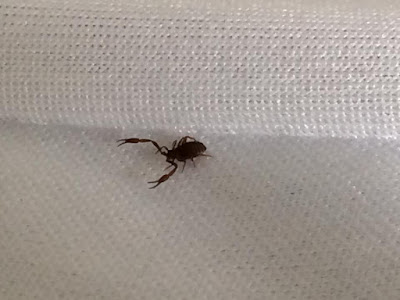
Our houses are more lively than we sometimes expect. We invite small creatures to live in our midst by hanging feeders and nest boxes outside our homes and while some respectfully keep to themselves, others will overstep their welcome. I was burgled a few months ago by a squirrel I rescued from our dumpster and while T.S. (Trash Squirrel) only took an apple, it was still a crossing of barriers.  That squirrel's neighbors also engage in remodeling efforts on the eaves and walls of the apartment, chewing holes for access to the warmth within. Other animals like starlings and wasps take over these holes when the squirrels leave, raising their young in a prefabbed space. We have small visitors as well.  The occasional spider or beetle will accidentally find itself inside our apartment and it will be my job to gently escort them outside to the hallway or swiftly eject out of the window, depending on my mood. More than often than not, our home is plagued by fruit flies. They sit...

Nature Note #127: Common Animal Misconceptions

Image
After working with 5th and 6th grade kids, you definitely have a different perspective on the world. You realize how hard it is for kids in school these days with deluges of exams, the new Common Core standards, parental expectations, lack of recess and adequate physical education, and much more. But more than that, most kids and by extension, most adults, know little about the natural world around them. Through my years in the environmental education field and musings while on my own travels through nature, I always wonder how much other people are noticing about what's around them. As such, there are a lot of misconceptions about the wild creatures that we are increasingly coming in contact with as habitat fragmentation, housing developments, and other human-wildlife conflicts become more common. No more is the occasional raccoon raiding the bins or bear steal seed from the feeders, the wilderness is here and we better learn to live with it. That being said, I found with teachi...