Posts

Nature Note #175: A Visit to the Camillus Forest Unique Area

Image
We are fortunate in Central New York to have so many natural areas within which to walk around and explore. Whether it be the many waterfalls of Ithaca or the pleasant expanse of forest and fields at the many conservation areas dotted around the countryside between the built up areas of the state, we are truly spoiled for choice. I had the fortune of walking around a lovely patch of meadow and forest with my parents a few hours ago. While my mum noted that it seemed that "only mad dogs and Englishmen would be out in the midday sun", we walked on nonetheless. The property was called the Camillus Forest Unique Area and is located 20 minutes from Marcellus up NE Townline Road. The property has a series of trails running along a large interconnected meadow with a huge deciduous forest at the top of the hill. Several times as we were walking near the forest, we were treated to some wonderful views of Camillus and beyond. The plant life was diverse and abundant, mix...

Nature Note #174: Wood Carver

Image
For thousands of years, human beings have been inspired and encouraged to create artwork that celebrates the diversity of the natural world. From early cave paintings of big game animals like mammoths and bison to the works of famous painters like John James Audubon and Louis Agassiz Fuertes, people have found countless ways to appreciate wildlife. My inspiration comes from the rustic wood carvings of ducks, geese, and other birds made by market hunters in the 1800s. The simplicity of their design combined with their rustic paint jobs and regional differences make them an interesting medium to look at. I've worked on woodcarvings of birds on and off for several years now and wanted to share some of my creations as well as the creative process behind them as well. Drawing from the decoys of yore, some of my first creations mirror the patterns of waterfowl and shorebird decoys represented along the Eastern shores of the United States. Carving decoys for hunting and shooting, eve...

Nature Note #173: Wild Neighbors

Today when I came home from work, I rescued a squirrel from our dumpster. It likely had jumped in through the chewed hole on the double plastic lids that protected our trash until it was ready to be hauled to another patch of earth further away. I wasn't surprised to see the squirrel in there at all. After all, they were the ones that chewed the hole. It's amazing to think that in a few, short generations, these wild animals have adapted to our ordered way of life. Now, even those of us that live within a small town can find evidence of our wild neighbors daily. Just the other evening, I came upon a sorry sight. There was a dead nestling on the grass next to the house. Even after nudging it with my toe, it didn't budge. It was likely one of the young starlings that jeered for their parents return to the eaves and tressels of the house, mouths stuffed with insects and worms. All except this one. It might have taken a step too far and fallen from its home on high. Or maybe ...

Nature Note #172: Macros in Marcellus

Image
After having lived in Syracuse for a year, town life in Marcellus isn't the most exciting, but it is a welcome break from the city. We no longer have to suffer the wail of sirens, the stomping of feet from our considerate upstairs neighbors, or the relentless rap music people would use in conjunction with horn honks to let their associates know that their ride was there. Fortunately away from all that ruckus, Alison and I spent Friday and Saturday at the annual Olde Home Days festival in our adopted town of Marcellus. We visited our local park to find that a whole carnival had been set up. After wandering around the makeshift carnival grounds, we decided to get a quick bite to eat there rather than going back home to our house. However, dining on carny food, while not our proudest moment, still wasn't as bad as having tried deep-fried Oreos. For anyone who has never had the pleasure of consuming deep-fried Oreos, I would recommend a more commonplace sweet treat like a slice...

Nature Note #171: Digiscoping (A Beginner's Guide)

Image
Before I go any further, I should clarify the title. When I say, "a beginner's guide", I'm not implying that I came upon some ancient knowledge in a dusty attic or buried chest somewhere. Instead, I'm writing this post from the point of view of a beginner who only just recently got a chance to try digiscoping. And from what I experienced this past weekend, it was marvelous. For those not familiar with the activity, digiscoping is the combination of the words "digital" and "scope" and involves photographing or filming something through a scope or other high powered optical device that is farther away and allows for easier observation than a conventional camera could normally be able to take. This is especially useful for birders and other wildlife watchers as it gives them a chance to observe an animal from a distance and to avoid disturbing it in its natural habitat. I started practicing this new wildlife observation trick this weekend at m...

Nature Note #170: Earth Laughs in Flowers

Image
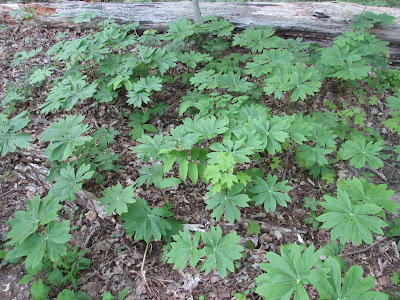
May-apples ( Podophyllum peltatum ) As summer steadily marches towards us, the countryside reminds us about the wonderful variety of wildflowers that flock the roadsides and dazzle the fields and woods. Flowers are a universal sign of nature and of her wonderful spread of colors, forms, and scents that blanket the landscape in the warmer months of the year. Many of the flowers we see along our roadsides and throughout our woods and fields are transplants brought over from Europe and Asia. Some like purple loosestrife ( Lythrum salicaria ) and garlic mustard ( Alliaria petiolata ) are nuisance species that take over areas of habitat that other native plants once thrived in. According to a report published in Ecological Economics , "an estimated 5000 plant species have escaped and now exist in U.S. natural ecosystems, compared with a total of about 17,000 species of native U.S. plants." (Pimental, Zuniga, and Morrison, 2004) This is damaging to many ecosystems found in ...

Nature Note #169: Can't See the Maples for the Mayapples

Image
Mayapples ( Podophyllum peltatum ) When you're out for a walk in the woods, little details can sometimes be lost in the majesty of the trees towering overhead, while summer birdsong rings through the foliage. While the woods are some of my favorite places to hike and bird in, this time of year offers me a chance to see one of my favorite organisms. Plants have the uber important role in most ecosystems as the chief providers of shelter, food, and most importantly, oxygen. According to North Carolina State University's Tree Facts page , a single tree can take in up to 48 pounds of carbon dioxide per year, cementing their value as invaluable converters of this greenhouse gas into an important breathable one. However, the plants I was admiring were not the trees, but a ground level plant grows in what looks like a shrunken and out of place colony of palm trees.  The May-apple is a common woodland plant that starts to appear in the Northeast in early May and continues t...